Flagship project

MeteorTest

The flagship project in the JC Meteor portfolio.

MeteorTest is an automation testing platform for managing projects, importing suites, scheduling local executors, collecting reports, and using AI to assist with project import, suite operations, task creation, report inspection, and failure analysis.

Next.jsSupabasePython AgentAI Operations
Control planeProjects / suites / tasks
Local AgentExecutor and report collector
AI assistProject, suite, task, and report operations

Execution loop

01Test project contract

The automation repository provides meteortest.yml, declaring suites, commands, required tools, and report behavior.

02Platform or AI import

MeteorTest reads the contract and registers the project suites, either through the Web console or through AI-assisted project operations.

03AI-assisted task creation

A user or AI assistant can create a task that binds the project, suite, environment, build artifact, and execution metadata into one run request.

04Local execution

The Python Local Agent claims the task and runs the declared pytest, Appium, or Locust command on the local machine.

05Report upload

Logs, status, Allure artifacts, screenshots, and execution summaries are written back to the platform.

06AI-assisted operations

MeteorTest uses platform context to help import suites, create tasks, inspect reports, summarize failures, and suggest the next action.

Background

Automation testing work often starts inside one repository, then spreads across products, environments, devices, reports, and local machines. MeteorTest is an attempt to make that execution loop visible and repeatable without moving every test into the platform itself.

Problem

The hard part is not only running pytest or Appium. The hard part is knowing which project, suite, app artifact, environment, executor, log, report, failure summary, and AI operation belong to the same run.

Approach

MeteorTest keeps the platform as the control plane and lets the Local Agent handle execution. Test repositories own their code and expose a meteortest.yml contract; the platform imports that contract and schedules tasks against it.
System responsibilities

MeteorTest platform

Owns project metadata, suite import, task state, reports, executor visibility, settings, and AI-assisted operation surfaces.

Local Agent

Claims queued tasks, prepares artifacts, runs suite commands, captures logs, and writes reports back to the platform.

Test project

Owns test code, fixtures, app-specific configuration, report output, and the meteortest.yml integration contract.

Capability overview

Project and suite managementBuild artifact registrationTask creation and queueingAI-assisted project, suite, and task operationsLocal executor statusLogs and Allure report collectionAI-assisted failure analysis

Available now

  • MeteorTest is still an MVP and active development project.
  • The Local Agent can execute the iOS-Automation-Framework API smoke suite through the test repository's own virtual environment.
  • The current API smoke tests have produced real pass/fail results against the iOS-Automation-Framework local mock API through MeteorTest Local Agent.
  • MeteorTest Web is online at meteortest.jcmeteor.com as a public preview.
  • Public preview mode keeps Local Agent execution private; public connected execution is not enabled.
  • The public website includes an interactive product walkthrough and project validation updates.
Validated local run

MeteorTest ran the mock-backed API smoke suite locally

A MeteorTest Local Agent task executed iOS-Automation-Framework `api_smoke` against the deterministic local mock API and collected task-specific logs plus Allure result artifacts.

Taskphase9-api-smoke-001
ResultSucceeded
Pytest6 passed
Exit code0

Run summary

  • Suite: api_smoke
  • Environment: local-mock-api
  • Runtime: iOS-Automation-Framework/.venv on Python 3.13
  • Selection: 6 smoke cases selected, 16 non-smoke cases deselected
  • Artifacts: output.log and Allure results collected under task-specific report paths

The public website still uses a browser-side mock demo, and the live Web preview keeps execution private. Public connected execution is a later design topic after authentication, data isolation, and executor safety are designed.

Local preview screenshots

MeteorTest Web is visible as a real console surface

These screenshots were captured from a local MeteorTest Web preview using sanitized mock data. They show the current console structure without exposing private Supabase data, local paths, credentials, or real test accounts.

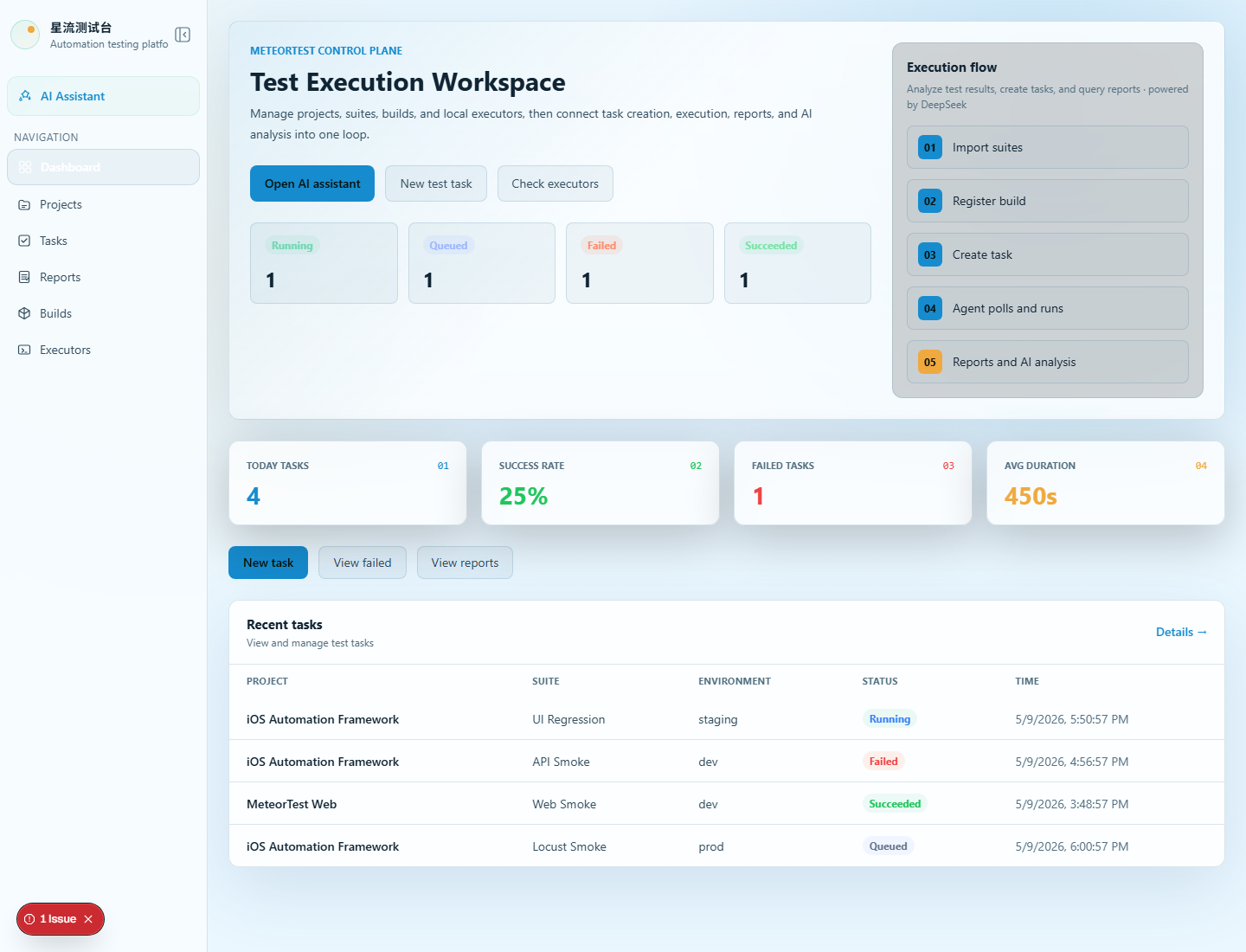
MeteorTest local dashboard preview screenshot

Execution workspace

The dashboard shows task status, project onboarding, executor health, AI-assisted entry points, and the execution loop in a populated console layout.

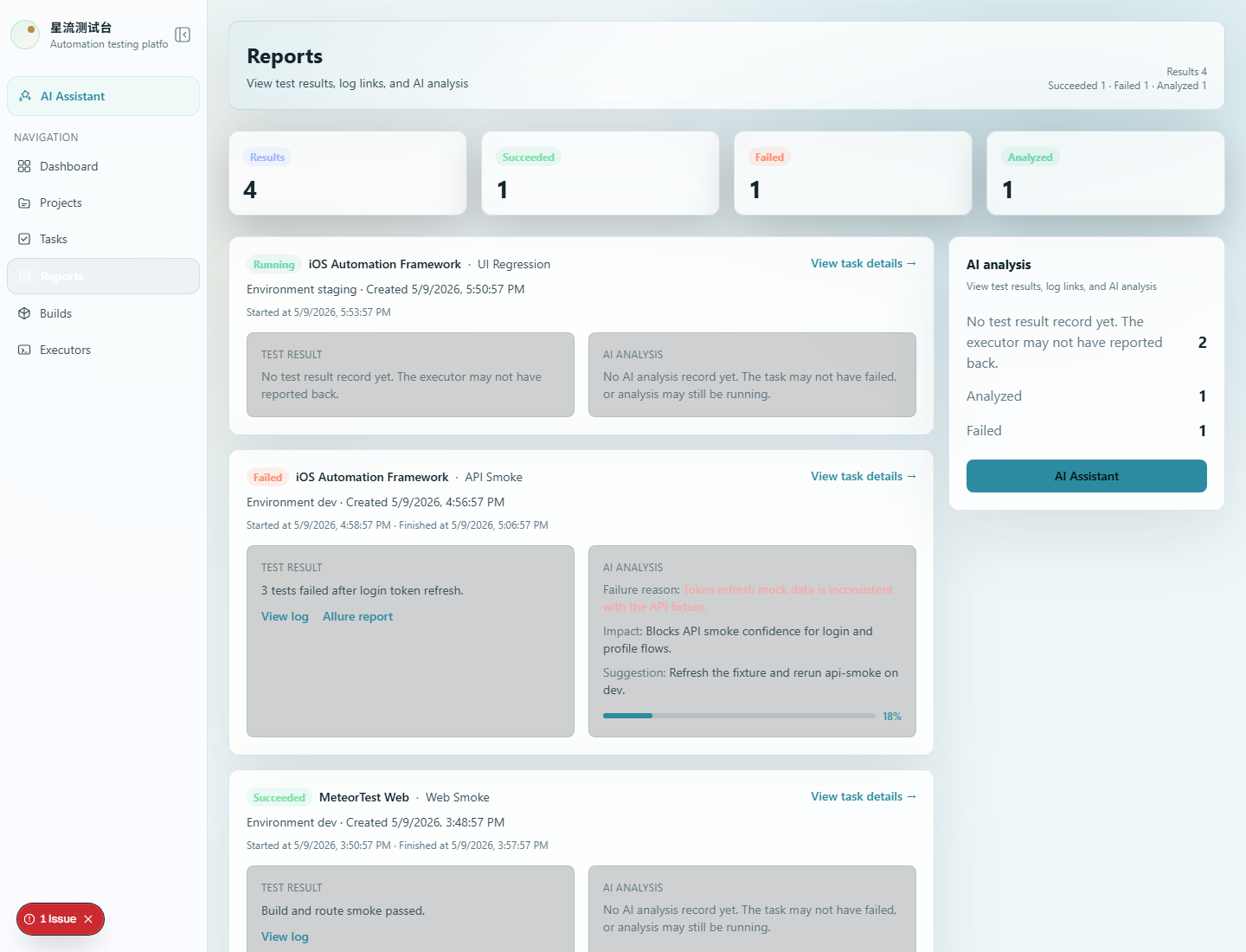
MeteorTest local report center preview screenshot

Report center

The report page shows task outcomes, failure context, report summaries, and AI analysis surfaces with mock execution data.

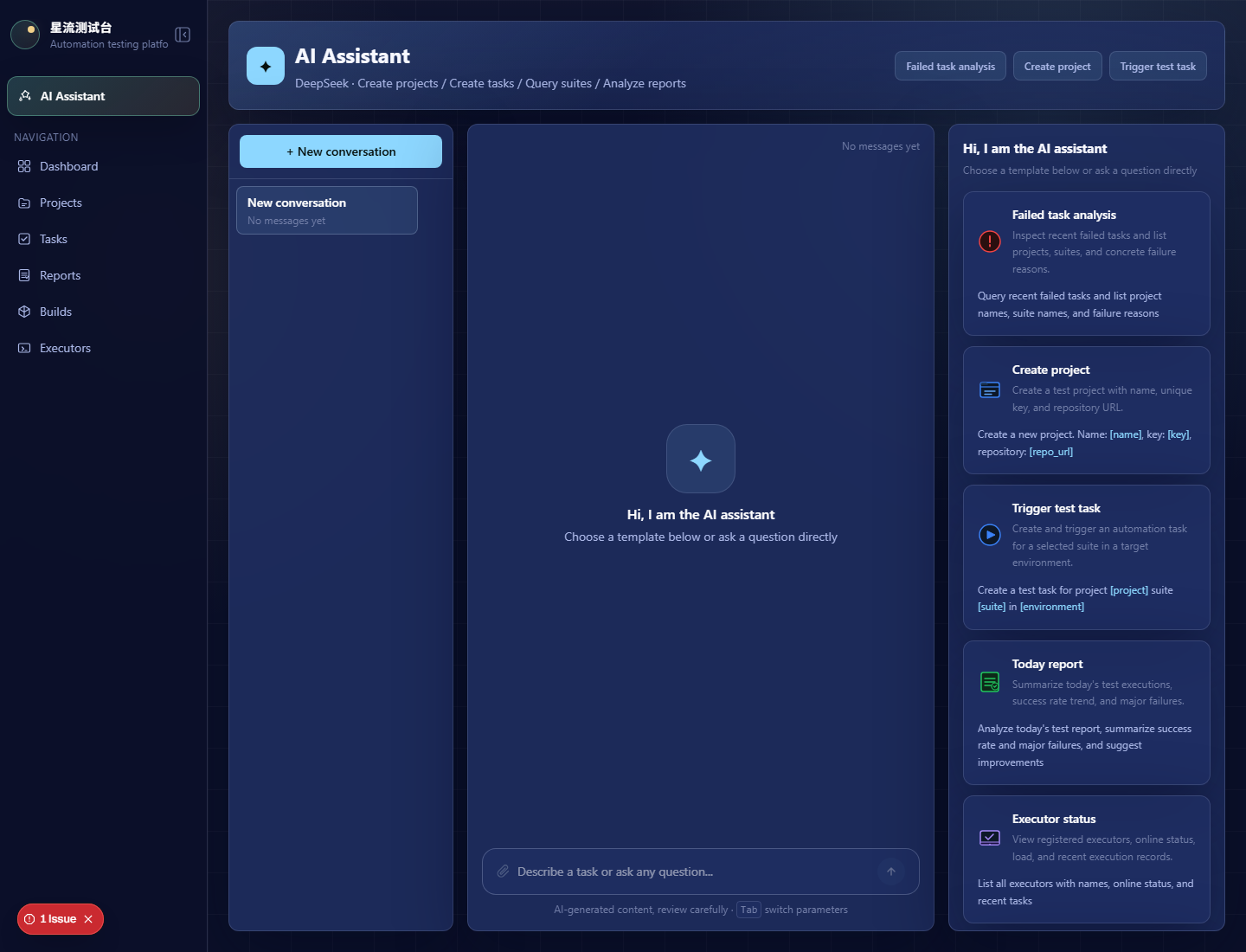
MeteorTest local AI operation console preview screenshot

AI operation console

The AI page presents conversations, executable quick templates, task-oriented prompts, and the assistant workspace as an operations surface rather than a simple chat box.

This is not a public connected demo. MeteorTest Web is now online as a public preview, but Local Agent execution remains private.

Demo status

Demo status

The current website demo is an interactive browser walkthrough that explains the project import, task preparation, Local Agent handoff, report context, and AI follow-up flow. The separate MeteorTest Web preview is online at meteortest.jcmeteor.com for console surface validation. Local Agent execution remains private, and public connected execution is still deferred.

Open interactive demo Open Web preview

Roadmap

Stabilize local executor lifecycle and task locking.
Improve report aggregation and failure summaries.
Turn the local run results into clearer product-facing website surfaces.
Harden the live MeteorTest Web preview with public-preview mode, access protection, demo data, and clearer task/report surfaces.
Design public connected execution only after security and execution isolation are explicit.